Fauna Report / Article
Why the vaquita is the world's most endangered marine mammal
Fewer than ten individuals remain, in one stretch of sea, killed not by hunters but by nets set for a different fish entirely. What's happened to the vaquita, and why it's so hard to stop.
The vaquita is a small, shy porpoise that most people will never see a photograph of, let alone the animal itself — and that obscurity is part of the story. It lives in exactly one place on Earth, it's disappearing for a reason that has nothing to do with anyone wanting it dead, and the most recent count puts its entire global population somewhere between seven and ten individuals.
An animal defined by where it isn't
Phocoena sinus is the smallest porpoise species alive, roughly 1.5 metres long, pale grey with dark rings around its eyes. It exists nowhere in the world except a roughly 4,000-square-kilometre stretch of Mexico's Upper Gulf of California, wedged between the Baja California peninsula and the Mexican mainland. It was only formally described in 1958 and has likely always been rare and geographically confined — but the collapse that's brought it to single digits is recent, fast and entirely human-caused.
The first proper survey, in 1997, estimated roughly 567 individuals. By 2015, modelling suggested the population had fallen by around 80% in just four years. The 2024 survey recorded a low of six to eight animals, with no calves sighted at all. The most recent count, from 2025, found seven to ten individuals and — for the first time in this run of surveys — new calves observed, which researchers describe as cause for cautious optimism rather than a reversal.
Killed by a net meant for someone else
The vaquita isn't hunted. Nobody sets out to catch it. It dies as bycatch, drowned in gillnets — walls of nearly invisible netting set in the water — that are meant for a different fish entirely: the totoaba, a large fish whose swim bladder sells for tens of thousands of dollars on the black market in China, where it's prized in traditional medicine despite no verified medicinal effect. The totoaba is itself critically endangered, targeted specifically because its swim bladder is valuable, and it happens to be almost exactly the vaquita's size — so a net built to catch one catches the other just as effectively.
This is what makes the vaquita's situation unusually hard to fix through the tools that work for hunted species. Banning trade in vaquita parts does nothing, because nobody is after vaquita parts. The species is being wiped out as a side effect of demand for something else, in nets it swims into by accident, in an area where a lucrative illegal fishery has strong financial incentive to keep operating.
A ban that exists on paper
Mexico published a formal agreement in 2020 to sharply restrict illegal fishing in vaquita habitat, including a "zero-tolerance" area where gillnets are banned outright. The gap between that policy and what happens on the water has been the central, unresolved problem ever since. Enforcement has been inconsistent, illegal totoaba fishing continues, and conservation groups working in the region have documented gillnets still being set inside the protected zone years after the ban took effect.
It's a pattern that shows up elsewhere in conservation — a legal protection that exists clearly on paper but depends entirely on enforcement capacity, and enforcement capacity that hasn't matched the scale or persistence of the illegal activity it's meant to stop.
What the population numbers actually mean at this size
At seven to ten individuals, ordinary population statistics stop being very informative, and the more useful lens is the one covered elsewhere on this site regarding minimum viable populations: a group this small is exposed to genetic erosion and simple bad luck in ways a larger population isn't. A skewed sex ratio in a single birth year, one bad season, a run of male calves — any of it could matter disproportionately when the total is measured in single digits.
Even the researchers who found reason for cautious optimism in the 2025 survey were direct about the scale of what recovery would require. Getting back to the 2015 population of around 60 individuals — itself already a fraction of the 1997 number — would take up to 20 years, if the gillnets disappeared from vaquita habitat starting now. They haven't yet.
Why "cautious optimism" is the right description, not a soft one
New calves in the 2025 survey are real evidence the species hasn't stopped reproducing, and after a 2024 count that found none, that matters. It doesn't change the fundamental math: the vaquita's single greatest cause of death remains a fishing method that's still, provably, active in its only habitat. A species can keep having calves and still be pushed toward extinction if the rate of accidental death in gillnets outpaces the rate of births — and at fewer than ten animals, there's very little room for that balance to tip the wrong way before there's nothing left to recover.
How to read the next vaquita headline
Three things are worth checking whenever a new vaquita count or policy update appears:
- Is the number from acoustic detection, visual sightings, or both? Recent surveys combine underwater listening devices with direct sightings from research vessels, and the two methods can give different pictures of the same small, elusive population.
- Were calves observed? A stable adult count with no calves is a very different signal than the same count with confirmed births.
- Is enforcement actually removing gillnets from the water, or is a ban simply being restated? The 2020 agreement has existed on paper for years; what changes the vaquita's odds is nets coming out of the water, not policy being reaffirmed.
The vaquita's story isn't one of habitat loss, climate change, or a slow multi-generational decline. It's a specific, well-understood, theoretically stoppable cause of death that has not yet actually been stopped — which makes it one of the clearest tests in conservation of the gap between what's legally banned and what's actually enforced.
Sources and further reading
- Scientific American — Two Vaquita Calves Offer Flicker of Hope for Most Endangered Porpoises on Earth — the 2025 survey finding seven to ten individuals and new calves, and expert reaction to the count.
- Sea Shepherd Conservation Society — Results of the 2025 Vaquita Monitoring Effort — full methodology of the acoustic and visual survey behind the 2025 estimate.
- Animal Welfare Institute — New Survey: No More Than Eight Vaquita Remain — the 2020 Mexican government agreement on gillnet restrictions and the enforcement gap since.
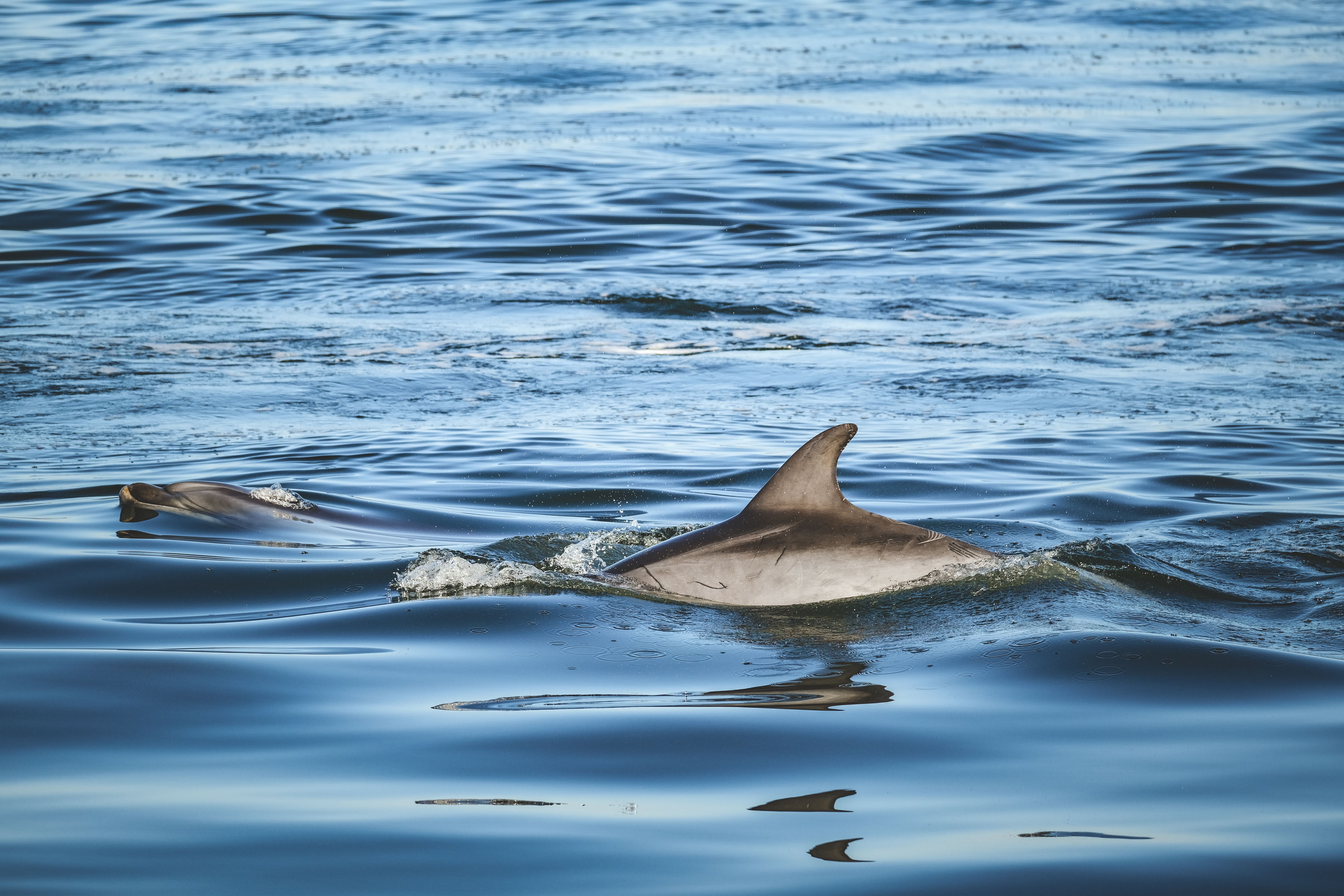
Illustrative photo: dolphins. The vaquita is very rarely photographed.